
Why our quality gate rejected an article that scored 85
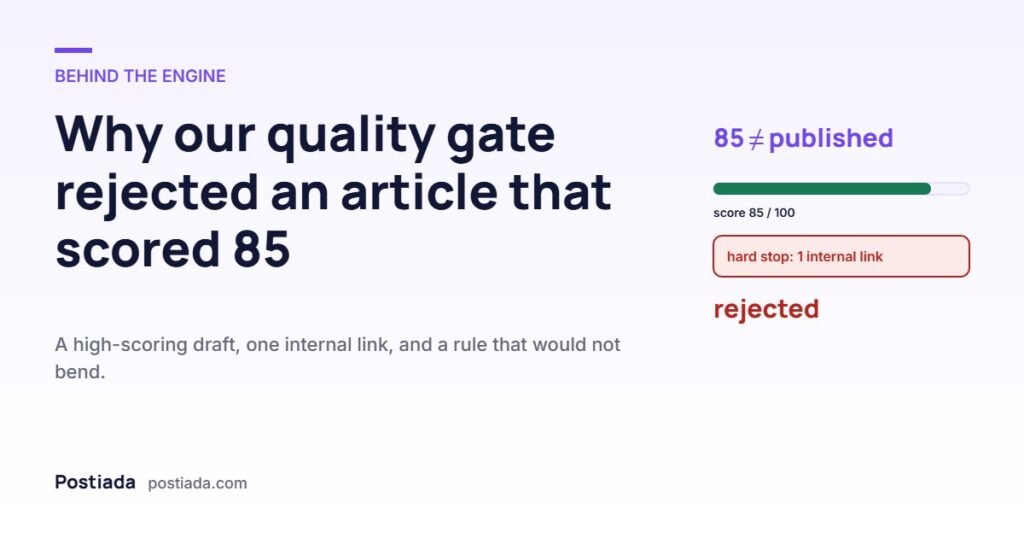
On 16 September the engine produced a draft with an SEO score of 85.1 — an A — and then refused to publish it. It contained one internal link. The minimum is three. Here is why we did not override the rule, and what sixteen rejected drafts taught us.
Two kinds of failure
Most content tools give you a score and let you decide. We split the decision in two. A score — twenty-two checks across SEO, answer-engine structure and generative-engine specificity — drives regeneration: below the threshold, the draft is rewritten up to three times and the best version wins. But a handful of rules are not scores at all. They are hard stops: an unverified number, a missing official source, fewer than three internal links, a broken link, a banned filler phrase, a commercial link in the introduction. Fail one and the article is held back, however good the rest of it is.
The 85-point draft failed a hard stop. It was a well-written piece about choosing a hamam that happened to link to only one other page on the site. Publishing it would have added a good article and a weak node to the site’s internal structure. Holding it back cost a day. We held it back.
“Three continents”
The rule that earns its keep most often is the one about numbers and claims. Istanbul sits on two continents. Language models, having read a great deal of travel marketing, are fond of saying three. In one test run, four drafts in a row were rejected for exactly that phrase — Topkapı, Galata, the Hippodrome. Each rejection cost one model call and prevented one embarrassing article.
The interesting case was the Hippodrome. The draft said the obelisk there is about 3,500 years old. That is true. The gate rejected it anyway, because 3,500 was not in the site’s verified facts file. We could have added an exception for “numbers that are probably right”. We did not, because the whole point of the rule is that the engine cannot tell a probably-right number from a confidently-wrong one. Humans verify facts; the engine enforces that only verified facts are used. The fix was to add the figure to the facts file, and the next draft passed.
What the photo check caught
The same philosophy applies to images. Before any photo is used — in an article or a social post — a vision model answers a short checklist: is the subject actually in frame, is it sharp, is it the right place, is anyone facing away, is there a watermark. In one afternoon it rejected a Dubai skyline that a stock search had returned for an Istanbul topic, a photo of a different tower for an article about Çamlıca, and the Maiden’s Tower for a piece about Hagia Sophia. None of those would have looked wrong at thumbnail size. All of them would have looked wrong to a reader who knew the city.
When no frame passes, the social post is skipped. A missing post is better than a wrong one — a rule we wrote down after the engine published a “PRICES DROP” headline it had no data for, and we deleted it by hand.
Sixteen rejections, four lessons
- Make the reason visible. Every held-back draft shows its reason in the workspace: “SEO 85 · rejected: 1 internal link (minimum 3)”. A gate that fails silently is a bug, not a safeguard.
- Do not soften hard rules for good drafts. The moment “but it scored 85” becomes an argument, the rule stops being a rule.
- Fix the input, not the gate. Most rejections pointed at a gap in the facts file or the internal-link index. Filling the gap fixed every future draft, not just one.
- Accept the cost. Around a quarter of drafts fail on the first pass. Each costs a few cents of model time. That is the price of never having to read every article before it goes out.
Why this matters more for automation
A human editor catches most of these things without a checklist. An automated publisher does not have an editor — it has rules, or it has nothing. The gate is what makes it possible to stop watching. Not because the engine never produces a bad draft, but because a bad draft never becomes a published page.
Frequently asked questions
What is the score threshold?
75 out of 100. Below it the draft is regenerated up to three times and the best version is kept.
Can a customer override a hard stop?
No. Hard stops are conditions of publication. You can fix the cause — add the fact, add the link — and the next draft passes.
How often do drafts fail?
In our September test runs, about one in four on the first pass. The rate falls as the facts file and internal-link index fill in.