
SEO, AEO, GEO: what actually changes when an AI answers the search
Three acronyms describe three ways people now find answers. The good news: the same well-built page can serve all of them. The bad news: most pages are not built that way.
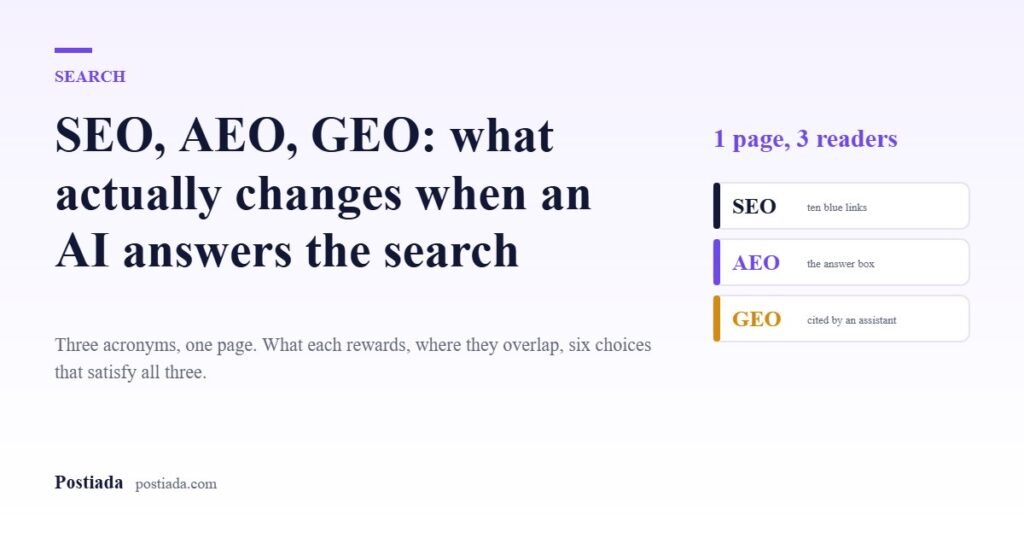
Three audiences for one page
SEO — search engine optimisation — is the one everybody knows. A person types a query, Google returns ten blue links, and your page competes to be one of them. What it rewards has been stable for years: a clear topic, a title and headings that match how people search, internal links that show the page belongs to a site with depth, and sources that show the claims are grounded.
AEO — answer engine optimisation — is about the box above the links. Featured snippets, “People also ask”, the direct answer at the top of the results. Google lifts these from pages that state the answer plainly and structure it visibly: a question as a heading followed by a short answer, a numbered list for a process, a table for a comparison, an FAQ with proper schema markup.
GEO — generative engine optimisation — is the newest. ChatGPT, Gemini, Perplexity and Google’s own AI Overviews do not return your page; they read it and write an answer, sometimes citing you, sometimes not. Studies of what these systems cite point in one direction: they favour text that is specific, sourced and unambiguous. Vague pages get paraphrased without credit. Precise pages get quoted with a link.
Where they overlap
Put the three side by side and the overlap is large. All three want a page that answers a real question. All three reward structure a machine can parse — headings that mean something, lists and tables rather than walls of prose. All three punish filler. The differences are in emphasis: SEO cares more about keyword placement and site authority, AEO about the shape of the answer, GEO about specificity and sourcing.
That overlap is why chasing one at the expense of the others is a mistake. A page stuffed with keywords but vague in substance ranks briefly and is never cited. A page with a brilliant FAQ but no internal links is an island. The efficient move is to build every page to the intersection.
Six choices that satisfy all three
- One question per page, answered in the first hundred words. State the answer before you explain it. Snippets and AI summaries both take the first plain statement they find.
- Headings that are questions or claims, not labels. “How long does a hamam visit take?” beats “Duration”. A heading that reads like a query is a heading that matches one.
- At least one list or table. Structured content is what gets lifted into answer boxes and quoted by assistants. Prose alone rarely is.
- A real FAQ, marked up as FAQPage schema. Five or more genuine questions with short answers. On WordPress, Rank Math’s FAQ block emits the schema for you.
- Specific numbers, with a source. “Opens at 08:00; last entry 21:00 (official site)” is citable. “Open long hours” is not. If you do not have a verified number, do not write one — a wrong figure costs more than a missing one.
- Internal links to three or more related pages, and one official external source. Internal links tell search engines the page sits inside a topic you cover in depth. The external source tells everyone the claims are grounded.
What to stop doing
Drop the phrases that signal filler to humans and machines alike: “in today’s fast-paced world”, “nestled in the heart of”, “hidden gem”, “delve into”, “whether you’re a…”, “prices vary”. They add length and remove trust. Our own quality gate rejects any draft that contains them, and the articles are better for it.
Stop writing to a word count. Write to the question; the length follows. Our articles land between 1,100 and 2,200 words because that is what answering a real question thoroughly tends to take — not because the number is a target.
How Postiada applies this
Every article Postiada writes is scored on twenty-two checks split across the three disciplines — forty points for SEO fundamentals, thirty for answer structure, thirty for generative-engine specificity — and regenerated if it falls below the threshold. The structural rules above are not suggestions in a style guide; they are conditions the article has to meet before it is published. That is the practical difference between knowing what good looks like and shipping it every week.
Frequently asked questions
Do I need three different pages for SEO, AEO and GEO?
No. One well-structured page serves all three. The disciplines differ in emphasis, not in the kind of page they reward.
Does FAQ schema still matter?
Yes. Even where Google shows fewer FAQ rich results than it used to, the marked-up question-and-answer pairs remain one of the clearest signals for answer boxes and AI summaries.
How specific is specific enough for GEO?
Specific enough to be checked: a number with a unit and a source, a name rather than a category, a date rather than “recently”.