Ranking on page one with zero clicks: what 69 Search Console queries told us
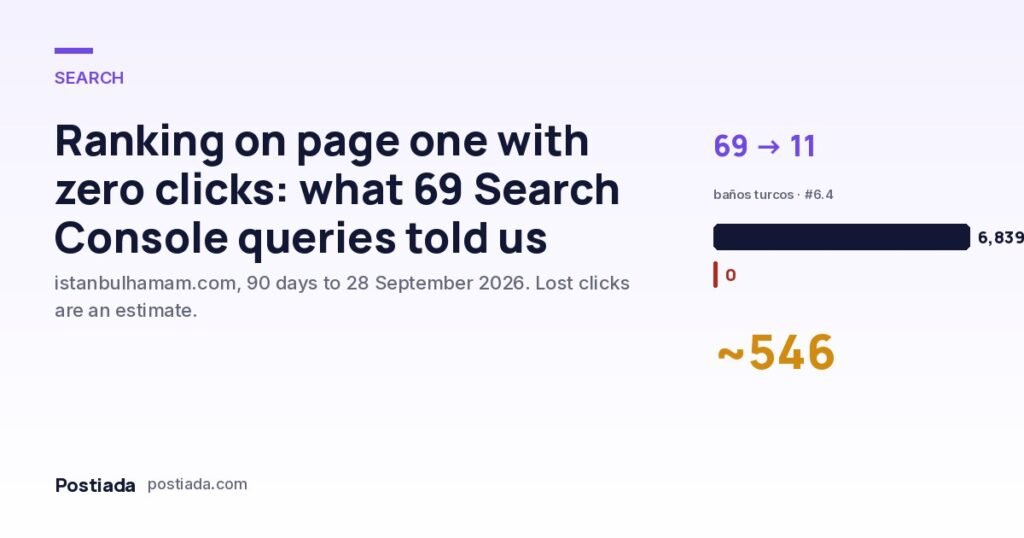
One query showed our page 6,839 times in ninety days and was clicked zero times. The fix is not a new article. Here is how we separate "write something" from "fix the title", and the list that came out of it.
Most SEO advice about Google Search Console stops at “find queries you rank for and write more about them”. That is half right and half harmful. A query where you already sit on page one and nobody clicks does not need another article — a second page would only compete with the first. It needs a better title, a better description, or the right page in the result. Postiada’s engine sorts every query into one of three classes before anything is written, and until 28 September 2026 one of those classes fell into a gap: it was correctly kept out of the article pipeline and then handed to nobody. This is what we found when we closed the gap on our own site istanbulhamam.com.
Which queries become articles, and which do not?
Search Console reports, for each query, how often your site appeared, at what average position, and how often it was clicked. It does not report search volume — that is Google’s market estimate, which we get separately from Keyword Planner. Impressions on your own site are a measurement; volume is an estimate; the engine treats the measurement as the stronger evidence. Every query with at least 30 impressions is then classified by average position.
Queries at positions 11–30 are “striking distance”: there is a page, it is on page two, and a supporting article can lift it. Queries beyond 30 are “buried”: there is demand and no real answer on the site, so a new article is justified. Queries at positions 1–10 are the click gap: the page is already on page one, the problem is that people scroll past it. Writing a new article for a click-gap query is the one move guaranteed not to help, so the rule has always been that these queries never enter the topic pool. The mistake was that they did not enter any other list either.
How big was the gap on a real site?
On istanbulhamam.com, over the ninety days to 28 September 2026, 69 queries sat on page one with a click gap. Eleven of them cleared our threshold of at least ten estimated lost clicks; together the list represents roughly 546 clicks the site did not get. Twenty-one of the 69 queries contained the name of one of our own venues — people were searching for a bath we operate, seeing us, and not clicking.
The four largest rows tell the story on their own:
| Query | Impressions | Clicks | Avg. position | Est. lost clicks |
|---|---|---|---|---|
| baños turcos | 6,839 | 0 | 6.4 | ~342 |
| cemberlitas hamam | 1,598 | 13 | 9.1 | ~35 |
| acemoglu historical hammam | 950 | 0 | 7.9 | ~28 |
| kilic ali pasa hamam | 1,178 | 8 | 7.6 | ~27 |
The third row is the one that stung. “Acemoglu historical hammam” is our own venue. We appear on page one for its name and did not receive a single click in three months. Until this list existed, that fact was visible in Search Console to anyone who thought to look, and nobody had.
For comparison, istambul.com — a portal rather than a product site — had no click-gap queries at all: 2 striking-distance and 33 buried. That is consistent with what we already knew about that site: it does not reach page one for product queries yet, so there is nothing on page one to be scrolled past.
How is “lost clicks” calculated, and how much should you trust it?
The estimate is impressions × (expected CTR at that position − actual CTR). The expected click-through rate per position is a rough stand-in for Google’s click curve; it is not something we measured, and it is not published by Google. So three rules apply to the number. Every row carries a “this is an estimate” flag and is shown with a tilde. If an expected-CTR table is missing, the loss is written as zero, never invented. And a query that is clicked better than expected produces no negative loss — the floor is zero. Treat the figure as a way to rank rows, not as revenue.
Why does knowing the page matter more than knowing the query?
The query dimension alone tells you that something of yours appeared. It does not tell you which page, and “fix the title” is not an instruction until you know whose title. So the Search Console fetch now also requests the query-plus-page dimension for the same window — the same property, one extra free request, and if it fails the run continues with a page-less list rather than failing. Where several of our pages appear for one query, the one with the most impressions is chosen. Google’s documentation of the Performance report explains how positions and impressions are attributed when that happens.
With the page attached, the diagnosis often reads itself. Three from the first run:
- For “hurrem sultan hammam”, the page on page one was a blog post, not the product page — the article outranks the page that sells.
- For “cemberlitas hamami” (the Turkish spelling), the ranking page was the German version of the site.
- For “kilic ali pasa hamami”, it was the French version.
None of those is a “write a better title” problem. The first is an internal-linking and canonical problem; the other two are hreflang problems on a multilingual site. Ten of the 69 rows — including “baños turcos”, the largest — came back without a page at all, and those rows do not turn into a fake title task; they stay in the list as “find which of our pages is showing first”.
What rules did we settle on?
| Rule | Value | Why |
|---|---|---|
| Click-gap queries enter the topic pool | Never | A new page would compete with the page already on page one. |
| Threshold to appear on the list | ≥ 10 estimated lost clicks per 90 days | Below that it is noise, not work. |
| List length | At most 20 rows | A 69-row list gives nobody a job. |
| Sort order | Own venues first, then by estimated loss | A missed click on our own name costs the most. |
| Refresh | Rebuilt on every Search Console run | The list is a view of the data, not a backlog to maintain. |
One limit is worth stating plainly. The site’s brand profile does not yet hold a list of competitors, so the engine cannot tell “a venue we do not operate” from “a generic query”; both are labelled general. That decision is left to a person looking at the page address — and in one of the four rows above it changed the answer: the venue is one we write about but do not sell, so a better title would bring visitors who cannot book. The useful change on that page is a clear route to the baths we do operate, not a sharper headline.
What this means if Postiada runs your site
The three-class sort runs from the first Search Console fetch, and the click-gap list is a screen in the workspace’s Analytics section — “queries that are not clicked” — each row with the page that showed. It is deliberately a short list of title, description and linking tasks — the kind of change that takes minutes and pays for a quarter — kept apart from the article pipeline, which only ever draws from striking-distance and buried queries. If you want the reasoning behind the article side of that pipeline, what changes when an AI answers the search covers it; the FAQ covers what we do and do not touch on your site.
Frequently asked questions
Is a click gap always a title problem?
No. In our first run the three diagnosable rows were a blog post outranking a product page, and two wrong-language pages ranking for Turkish spellings. Titles were the problem in none of them. Attach the page before deciding.
Why is the threshold ten lost clicks rather than a CTR percentage?
Because a 0% CTR on 40 impressions and a 0% CTR on 6,839 impressions are not the same job. Estimated lost clicks weights the gap by how often it happens.
Does Search Console give search volume?
No. It gives impressions, clicks and position for your own site. Volume is a separate estimate from Keyword Planner, and the engine keeps the two on different footings: measured beats estimated.
How often is the list rebuilt?
On every Search Console run, from a rolling 90-day window. Rows disappear when the click gap closes; nothing has to be ticked off by hand.